A single German bombing run in October 1941 created what is now the most dived wreck on the planet. The SS Thistlegorm sits in 16 to 32 meters of water off Egypt’s Sinai Peninsula, its cargo holds still packed with motorcycles, trucks, and rifles the way they were loaded over eighty years ago, and it’s the reason most Egypt liveaboard diving itineraries exist in their current form.
We built this guide around her, from the ship’s wartime construction to the night she sank, and how we get our guests onto her deck today.
What Makes the Thistlegorm Worth Building a Trip Around?
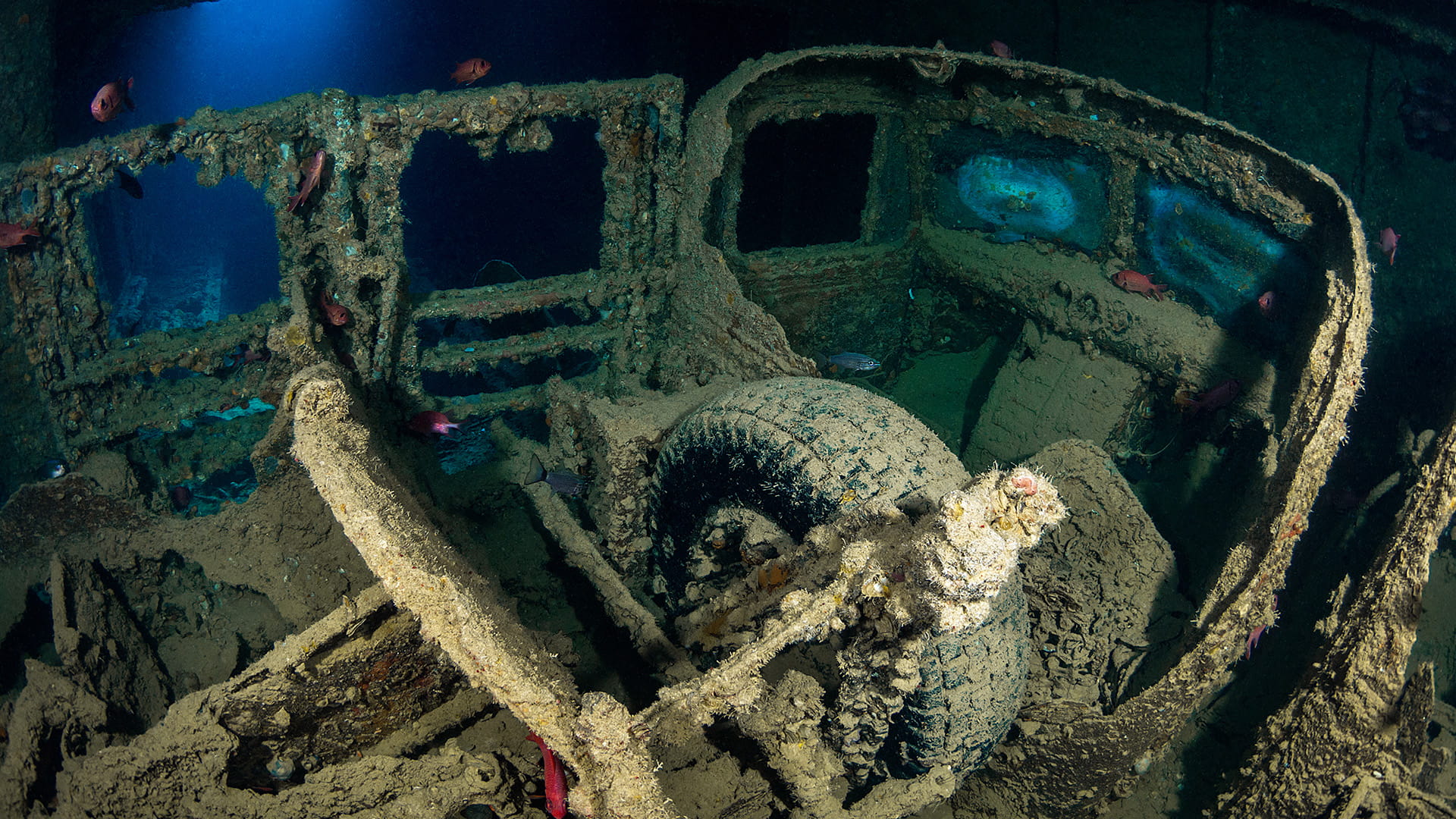
- Built in 1940 as an armed British freighter, the Thistlegorm was sunk by a German air attack on October 6, 1941, while anchored in the Red Sea waiting to transit the Suez Canal.
- Jacques Cousteau rediscovered the wreck in 1955 and kept its coordinates secret for decades, until dive operators relocated it in 1991 and it became the centerpiece of Red Sea wreck diving.
- The wreck sits at 16 to 32 meters and is best suited to divers with some depth experience, given the size of the ship and the penetration opportunities inside her holds.
- Two steam locomotives were blown clear of the hull in the explosion and now rest upright on the seabed beside the wreck, along with trucks, motorcycles, and munitions still inside.
- We run three liveaboards built for this kind of Red Sea liveaboard diving, DUNE Longara, DUNE Titan, and DUNE Silky, each reaching the Thistlegorm as part of our North Red Sea itineraries.
Built for War: The Thistlegorm’s Construction and Final Voyage
The Thistlegorm was built in April 1940 by Joseph Thompson & Sons in Sunderland, England, for the Albyn Line. She was a 126.5-meter (415 ft) armed steam freighter weighing roughly 4,898 gross tons, classified as a Defensively Equipped Merchant ship and fitted with a 4.7-inch anti-aircraft gun and a heavy-caliber machine gun on the stern.
She set sail in June 1941 from Glasgow, bound for Alexandria to resupply the British Eighth Army. To avoid Axis activity in the Mediterranean, she took the long way around, sailing around the entire African continent via the Cape of Good Hope and up into the Red Sea. Her holds carried trucks, BSA and Norton motorcycles, Lee-Enfield rifles, Bren gun carriers, aircraft parts, radio equipment, boots, and munitions, with two Stanier 8F steam locomotives and their tenders secured to the main deck.
The Night the Thistlegorm Sank
Arriving at the Straits of Gubal, the Thistlegorm was ordered to hold at “Safe Anchorage F” near Sha’ab Ali after a collision blocked the Suez Canal. She sat anchored there for two weeks, waiting.
On the night of October 5 to 6, 1941, two Luftwaffe Heinkel He 111 bombers flying out of Crete spotted the stationary fleet while hunting for a large troop transport. At 1:30 AM, two bombs struck Cargo Hold 4, detonating the high explosives and ammunition stored inside. The blast tore the ship in two and launched the two multi-ton deck locomotives off the hull into the surrounding seabed. She sank rapidly. Of the 41 crew members and gunners aboard, 9 lost their lives, and survivors were rescued by the nearby escort ship HMS Carlisle.
From Cousteau to the Dive Boom: Rediscovering the Wreck
Jacques-Yves Cousteau rediscovered the wreck in 1955, using information from local Bedouin fishermen. He raised several artifacts, including the captain’s safe, and featured the site in National Geographic in 1956 and in his documentary The Silent World. He kept the exact coordinates secret afterward, and the wreck sat mostly forgotten by the Western world for decades.
Dive operators relocated her in 1991, and the Thistlegorm quickly became the undisputed highlight of Red Sea liveaboard diving, and arguably the best place for wreck diving in the Red Sea full stop. Today she sits upright on a sandy seabed, acting as an underwater World War II museum and a genuinely vibrant artificial reef, which is exactly why she draws divers back for multiple dives rather than just one.
Diving the Thistlegorm With DUNE
Our North Red Sea itineraries are built to reach the Thistlegorm and marine havens like Ras Mohamed directly, and it’s the itinerary most guests ask us about by name. If you want the fastest route to her deck, our North, Dahab and Tiran route aboard DUNE Longara is one of the more direct ways to get there.
We run three vessels for this kind of wreck liveaboard diving, each suited to a slightly different traveler. DUNE Longara is our high-capacity, 30-guest flagship, combining five-star comfort with an onboard Jacuzzi, fine dining, and free Nitrox for certified divers. DUNE Titan is a broad-decked 39-meter liveaboard built for diving enthusiasts and photographers, hosting up to 30 guests with dedicated camera facilities. DUNE Silky is a more intimate 44-meter steel vessel for up to 26 divers, with panoramic upper-deck cabins and a quieter atmosphere overall.
The Thistlegorm at a Glance
| Detail | Fact |
| Built | April 1940, Sunderland, England |
| Sunk | October 6, 1941, German air attack |
| Casualties | 9 of 41 crew and gunners |
| Rediscovered | 1955, by Jacques Cousteau |
| Relocated for diving | 1991 |
| Depth | 16 to 32 meters |
| Notable cargo | Trucks, motorcycles, rifles, 2 steam locomotives |
What Divers Say About Wreck Diving Here
How deep is the Thistlegorm wreck?
She sits between 16 and 32 meters, with the main deck around 28 meters and the seabed close to 30. That range puts her within reach of divers with some depth experience, though penetrating the cargo holds adds a level of complexity best suited to more experienced wreck divers.
Can beginners dive the Thistlegorm?
Beginners can dive the upper sections with a guide, but the more complete experience, including hold penetration, is better suited to advanced open water divers or those with deep diving certification. A liveaboard gives you the option to build up to it across multiple dives rather than one rushed visit.
Which DUNE liveaboard is best for reaching the Thistlegorm?
All three of our vessels, DUNE Longara, DUNE Titan, and DUNE Silky, include the Thistlegorm on their North Red Sea itineraries. DUNE Longara tends to suit guests who want more onboard comfort, DUNE Titan suits photographers with its dedicated camera facilities, and DUNE Silky suits smaller groups after a quieter trip.
Ready to See Her for Yourself?
Eighty years on, the Thistlegorm is still one of the main reasons people plan an Egypt liveaboard diving trip in the first place, and multiple dives across a few days remain the only real way to take in everything from the stern guns to the cargo still sitting in her holds. If she’s the only reason you dive the Red Sea wrecks this year, that’s reason enough.
Check current North Red Sea departures: liveaboard.dune-world.com
Ask us which vessel fits your trip: booking@dune-world.com
Read more about Red Sea wreck diving: our Red Sea liveaboard guide